Car won't start: 3 common causes. Steps to diagnose
Updated: January 24, 2023
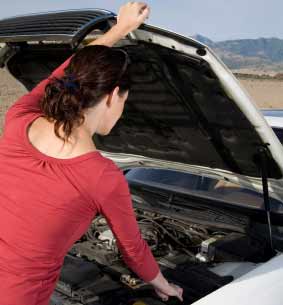
Of course, you can call your local automobile association or a towing service and have your car towed to a local repair shop, but if you want to know why it doesn't start, scroll down for steps to diagnose below. If your engine turns over (cranks) normally but won't start, read this article: 10 Reasons the engine cranks but won't start.
The 3 most common causes for a car not to start are:
- Low Battery. It's the most common reason. The battery could fail if it's more than 5-7 years old or simply be low on charge. In either case, the vehicle may need to be boosted to start.
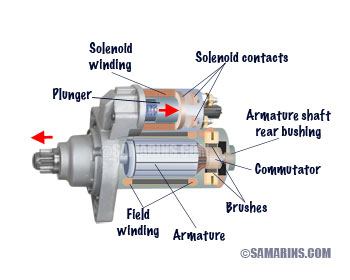
- Starter Motor Problems. The starter motor is the part that turns over the engine and it is common to go bad too. The starter motor may also stop working because of a poor connection at the starter control wire terminal or corroded/loose battery cables or terminals.
- Starting System is Disabled. Before the engine is allowed to start, several conditions need to be met, such as: The engine computer must be powered. The vehicle must be in Park or Neutral (Automatic). The security system (immobilizer) must recognise the key. The brake pedal (Automatic) or the clutch pedal (Manual) must be depressed. The ignition switch must work. If any of these conditions are not met, the starting system is disabled.
1. Low Battery
Symptoms of a low battery include:- No lights on the dash and exterior lights not working (when the battery is completely discharged).
- Lights on the dash come ON, but when turning the key to start or pressing the Start button nothing happens or the dash lights go dim (when the battery has enough charge to power the lights, but not enough to run the starter motor) Watch this video example.
- When starting, the starter clicks once or repeatedly, but won't turn over the engine. Or, the starter turns over the engine slowly and then stops (when the battery has some charge but not enough to start the car).
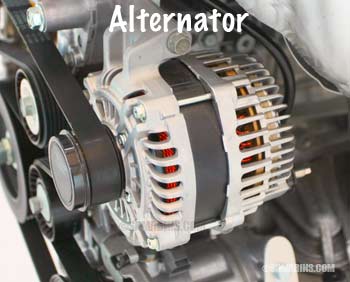
If the battery is low on charge and not very old, it can be recharged. One way to do this is to boost your car's battery from another car or from a portable booster, start the car and let the engine run for a while. When the engine is running, the alternator supplies power to recharge the battery. Read below about boosting the battery.
However, if the battery is more than 5-7 years old, it might be completely dead (has low capacity), so even if you boost it and charge it, it won't hold charge and the car will not restart again after you shut it off. In this case, you might need a new battery.
Can a bad alternator cause the car not to start? Not directly: If the alternator is bad it will not recharge the battery and after a while the battery charge will be too low to start the car. However if the battery is good and charged, the car will start even with a not working alternator. Read more about the alternator.
Battery State of Charge versus Capacity: Battery's Capacity is how much charge it can potentially hold and is usually measured in Cold Cranking Amps or CCA. State of Charge is how much charge the battery holds at the moment.
One way to check the state of charge of the battery is to check the battery voltage with a multimeter. A fully-charged 12-Volt battery should have 12.6 Volt.
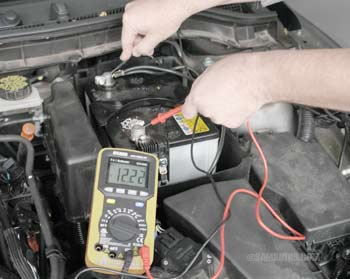 Measuring battery voltage
To check the battery's capacity, the battery must be charged first and the voltage must be checked under load. If the battery voltage is close to 12.6 Volt (fully charged), turn the headlights ON and measure the voltage again. If the voltage drops below 12 Volt within 30 seconds, the battery is weak or in technical terms its capacity is low. A good fully-charged battery at full capacity will maintain more than 12 Volt even after 10 minutes with headlights ON.
If the battery has low capacity, it must be replaced. Your repair shop can test your battery's capacity and state of charge more precisely with the battery tester.
2. Starter Motor Problems
The starter motor is a heavy-duty DC motor, but over time it wears out. It may go bad gradually, first giving intermittent problems or it may just fail one day.Symptoms of starter motor problems include:
- The battery has enough charge, but when starting whether in Park or Neutral nothing happens (if the starter motor has failed or is not receiving power due to bad connection at the terminal or for other reasons)
- The battery is OK, but the starter motor only makes a single click (for example, when the starter solenoid contacts or starter motor brushes are worn out)
- The battery is OK, but the starter motor is making a grinding or 'strained' sound and is turning over slowly when starting the car (if there is a mechanical problem, such as worn starter motor shaft bushings or bearings)
- The starter makes the sound like it's running, but won't turn over the engine (when the starter gear won't engage with the flexplate or flywheel gear of the engine due to a mechanical problem)
3. Starting System is Disabled
The starter motor is controlled by the engine computer, called Powertrain Control Module or PCM. Before the starter motor is allowed to operate, the engine computer must be powered and it must check:- If the security system code of the key or fob matches the code stored in the engine's computer. If the security light is flashing, there could be something wrong with the key or the security system. Read about the security system below.
- If the transmission is in Park or Neutral. If the car starts in Neutral but doesn't start in Park, it could be due to a problem with a transmission range switch.
Read more: 2 Reasons Why a Car Won't Start in Park but Starts in Neutral. - If the vehicle has an automatic transmission, the computer checks if the brake pedal is depressed. If the brake light switch or circuit is not working, the car will not start.
- In some cars the steering lock must disengage before the car can be started. If there is a problem with an electric steering lock, the car will not start. For example, some BMWs and Nissan vehicles had problems with the electric steering lock.
Steps to diagnose:
The process that goes on from the moment you put the key into the ignition to the point where the engine is running involves a few steps. Once you know at which step things go wrong, you will have a better idea what causes your car not to start and what to do. If your car starts with a "Start" button instead of an ignition key, follow to this article Why a car won't start when you push the Start button?Answer these questions; if the answer has a link, follow it; if not, continue to the next questions.
What happens when you are trying to start the engine?
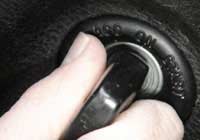 Ignition key
2. When you turn the ignition ON:
Do the lights come ON in the instrument panel? Yes No
Does the "Security" or Key-shaped warning light stay ON or blink repeatedly? Yes No
Does the "Check engine" light come on? Yes No
3. What happens when you turn the ignition key to the "Start" position?
- Nothing happens, the engine won't turn over.
- There is a click (or repeated clicking) but the engine won't turn over.
- The engine turns over (cranks) very slowly.
- The engine cranks progressively slower, then just clicks repeatedly.
4. Does it help if you jiggle the key in the ignition while starting? Yes No.
If the starter cranks normally, but the car won't start, read this guide: The engine cranks but won't start »
What to check if the car doesn't start
• Does the car battery have enough charge? Read above how to check the battery.• If the car doesn't start with the transmission in "Park," does it start in "Neutral"? Read more: 2 Reasons Why a Car Won't Start in Park but Starts in Neutral
• Is the "Security" or key-shaped light in the instrument panel staying ON or blinking? Read below about the security light.
• Does your car have an anti-theft system that for some reason doesn't allow the car to be started?
The key won't turn in the ignition
If the key won't turn in the ignition, it could be for a couple of reasons:Advertisement
Another possibility is that there is a problem with the ignition lock or the key itself. This happens; the key and the lock mechanism wear out over time. Try using a spare key. Sometimes spraying WD-40 or other lubricant inside the key slot can help. If nothing works, and the key won't turn in the ignition, call your local dealer or a locksmith.
No lights on the instrument panel
If you turn the ignition ON and there are no lights on the instrument panel, it means that there is no power coming from the battery. It could be because the battery is low on charge or has failed completely, or due to a loose battery terminal or something like a bad ignition switch, blown main fuse or not working main relay.Turn the headlights ON, if they work, means the battery has power, so the problem could be with the ignition switch, fuses, main relay or the wiring between the ignition switch and battery. If the headlights don't work, the battery could be completely discharged. Boosting the battery may help; read below.
"Security" or Key-shaped light stays ON or flashes repeatedly
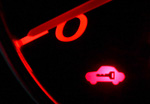 Security warning light
The ignition key or fob has a chip inside with the security code. When you insert the key into the ignition, a sensor for the security system verifies the code.
Normally when you turn the ignition on, you would see a "Security" light coming ON for a short time and then it would come off. This means that the code in the ignition key is correct, and the car is allowed to start.
If when you turn the ignition ON, the "Security" light stays ON or flashes repeatedly, it means that your car security system does not recognize the key or there is some problem with some part of the security system itself. You can find more information about the immobilizer in your owner's manual.
If you have a fob and a Start button, the security system communicates with the fob wirelessly. If the fob checks out OK, the key light on the dash turns green. If the amber or red key light is staying ON or is flashing, there could something wrong with the fob. Try holding the fob close to the Start button when starting. Read more here: Why a car won't start when you push the Start button?
Some GM cars, for example, had a problem with the security system sensor located at the ignition lock. Sometimes, the key just needs to be reprogrammed. In some older cars, there was a simple procedure to re-learn the key that would fix this problem. You can find the information on how to re-program the key in your owner's manual or just Google it. Try the spare key and if nothing works, your dealer is the place to call. In most modern cars, only an authorized dealer can reprogram the key.
The "Check Engine" light does not come on
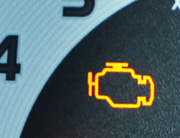 Check Engine light
If the Check Engine light does not come with the ignition ON, it's possible that there is no power coming to the engine computer (e.g., due to a broken wire, faulty main relay, blown fuse) or there is a problem with the engine computer itself. Read also: how to check a fuse.
The starter won't crank
If nothing happens when you turn the ignition key to the "Start" position, it means that the starter motor doesn't turn over the engine. Most commonly this could be caused by a low battery; read above How to check the battery.If the battery checks out OK, but the starter still won't crank, there could be a number of possible reasons. Here are some of them:
• The starter motor itself or a starter solenoid could be bad - it's a common problem at higher mileage. Read more about the starter motor.
• The ignition switch could be bad - it's also a fairly common problem. An ignition switch is an electrical switch installed at the back of the ignition lock mechanism. If jiggling the key in the ignition helps start the car, the ignition switch should be checked first. See this video.
• The starter solenoid control wire could have a bad connection.
• Problem with a neutral safety switch. If a car doesn't start with the transmission in Park, but starts in Neutral, it could be because of a problem with a neutral safety switch (transmission range switch) or the shifter cable. For example, watch this video.
Read more: 2 Reasons Why a Car Won't Start in Park but Starts in Neutral.
• Problems with the vehicle's security system or some other electronic control module (e.g., TCM, BCM) may also prevent the starter from operating.
I can hear a click, but the starter won't crank
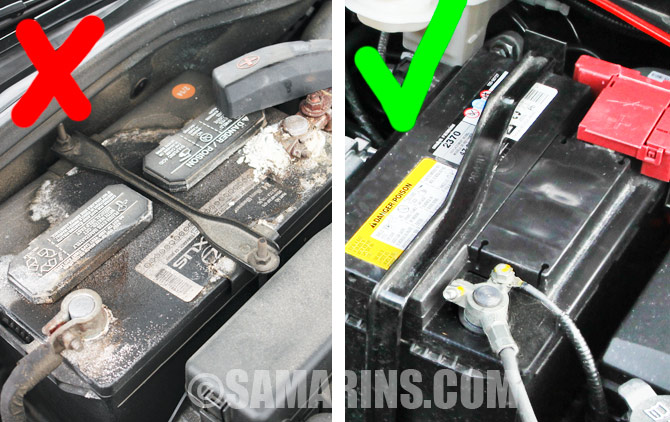
It's a very common problem: you turn the key to the "Start" position, but the engine won't crank; all you hear is a single click or repeated clicking coming from the engine compartment. Very often this could be caused by a weak battery. Read above: how to check the battery. A poor connection or corrosion at the battery terminals or cables can also cause this issue. Even a bad connection between the negative battery cable and the engine (bad ground) can cause the same symptoms.Check the battery terminals to make sure they are tight and not corroded. Here is a photo of a corroded battery terminals. If the battery is OK and the battery terminals appear clean and tight, the starter solenoid or the starter motor itself could be bad. A starter motor is common to fail at higher mileage. Read more: Starter motor, starting system.
The engine cranks very slow and won't start
This also might be caused by a weak or discharged battery; read above how to check the battery. If the battery is OK, the battery cables could have a bad connection at the terminals or the starter motor itself could have a problem.Sometimes, the starter motor armature bushings wear out and the starter armature rubs against the field coils inside the starter motor; this will also cause the starter motor to grind and crank very slow. If this is the case, the starter motor will need to be rebuilt or replaced.
Another possible reason is that the engine could have an internal mechanical problem (e.g., lack of oil, very old engine oil). Check the engine oil, just in case. Read here: how to check engine oil.
The engine cranks progressively slower, then just clicks
If the engine cranks slower and slower until it just clicks, it means the starter motor doesn't have enough power to turn over the engine.Once again, a weak battery is the most common culprit in this case. A bad starter motor can also cause this issue. Poor connection or corrosion at the battery terminals or bad battery cables can cause these symptoms too.
Jiggling the key helps start the car
Sometimes, if there is a problem with the ignition lock or ignition switch, jiggling the key may help. For example, there was a common problem in older Ford Escape and other trucks where a bad ignition lock module would cause the vehicle not to start, but jiggling the key would help. Watch this video.Boosting the car battery
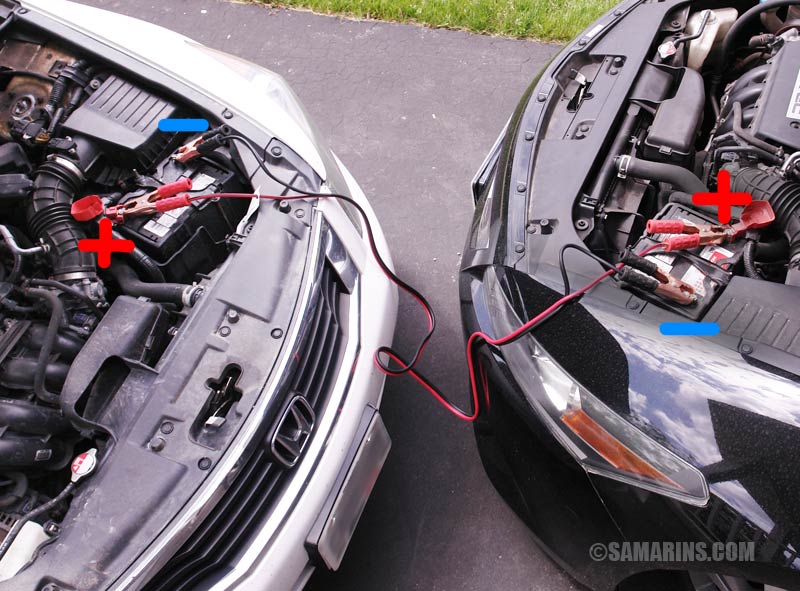 Boosting a weak battery from a good battery in another car.
Check your owner's manual for the correct way to connect the cables, because different cars have different locations of the positive and negative connection points.
Turn the engine off in the vehicle with a good battery. It's very important to connect the jumper cables the right way (positive to positive, negative to negative), so follow instructions in the owner's manual carefully - we know many cases when accidentally mixing the positive and negative cables while boosting a car caused more damage. For example, several fuses might be blow as a result.
When a portable booster or booster cables are connected firmly and correctly as per owner's manual, try starting the car.
 © Samarins.com 2000–2025. All rights reserved.